

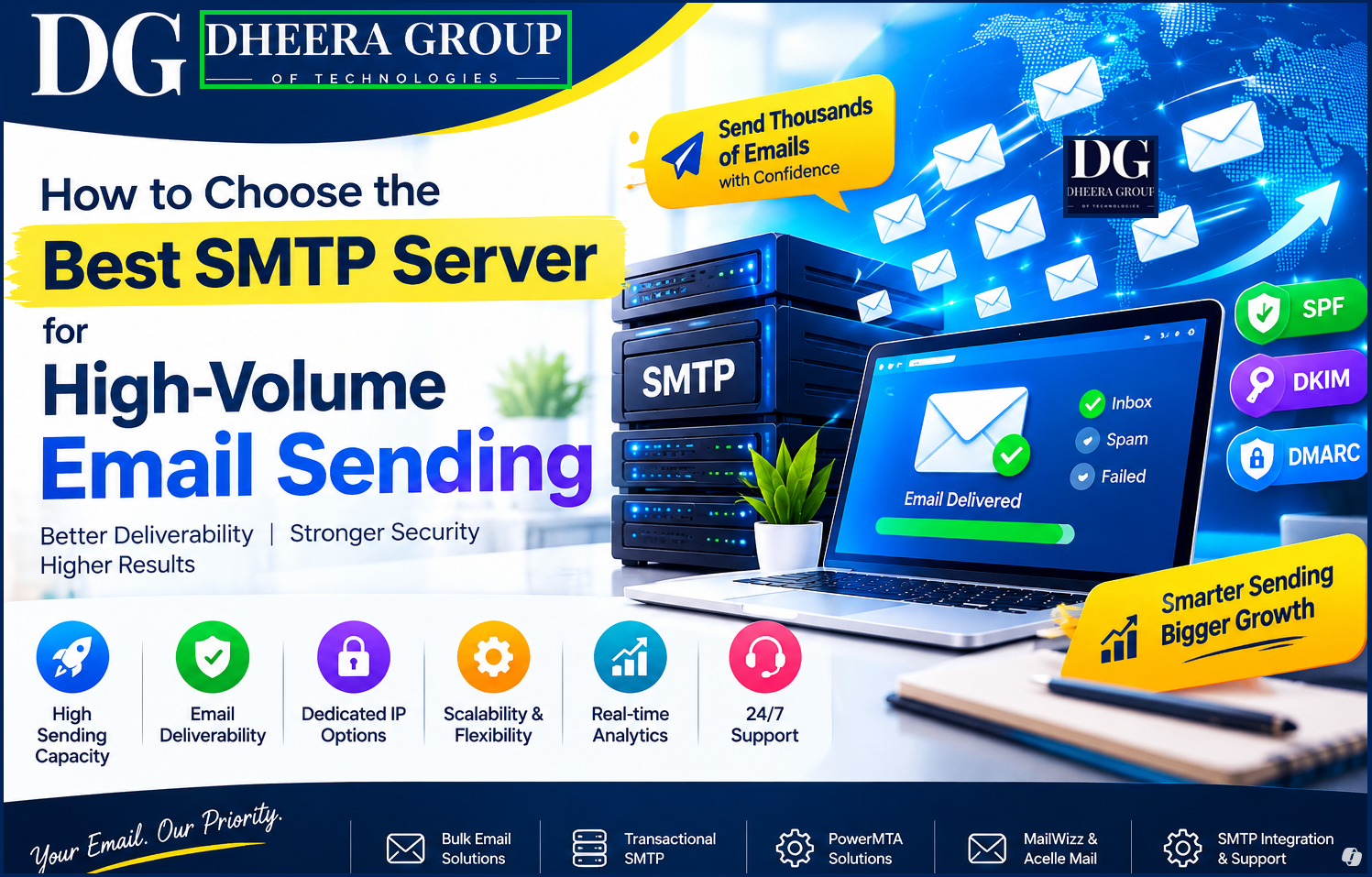

Sending thousands of emails is easy. Getting those emails delivered to the inbox consistently is the real challenge.
For businesses running email marketing campaigns, transactional notifications, newsletters, customer alerts, or large-scale communication, choosing the right SMTP server for high-volume email sending can have a major impact on deliverability, sender reputation, performance, and overall marketing ROI.
But with so many SMTP solutions available, how do you know which one is right for your business?
This guide explains the most important factors to consider before choosing a high-volume SMTP server.
What Is an SMTP Server?
SMTP stands for Simple Mail Transfer Protocol. It is the technology used to send emails from a sender’s mail server to the recipient’s mail server.
When you send an email, the SMTP server helps handle the delivery process between your application, website, email software, and the recipient’s mail provider.
For businesses sending email at scale, a reliable SMTP infrastructure can help manage:
- High-volume email delivery
- Marketing campaigns
- Transactional emails
- Customer notifications
- Password reset emails
- Order confirmations
- Newsletters
- Lead-nurturing campaigns
- Automated email sequences
However, simply having an SMTP server isn’t enough. Infrastructure, authentication, reputation, sending practices, and monitoring all matter.
Why Choosing the Right SMTP Server Matters
A poor SMTP setup can create several problems:
- Emails landing in spam
- Delayed email delivery
- IP reputation problems
- High bounce rates
- Authentication failures
- Sending limitations
- Poor campaign performance
- Increased chances of domain or IP blocking
For high-volume senders, these issues can directly affect customer communication and revenue.
Google’s current sender guidelines require bulk senders to Gmail accounts to use SPF, DKIM and DMARC, maintain valid DNS configuration, use TLS, and keep spam rates below Google’s stated threshold.
That’s why your SMTP server should be selected based on deliverability and reliability—not just price.
10 Things to Check Before Choosing an SMTP Server
1. Check Sending Capacity
The first question is simple:
How many emails do you need to send?
A small business may send a few thousand emails per month, while an e-commerce company or marketing agency may send hundreds of thousands or millions.
Before purchasing an SMTP solution, check:
- Monthly sending capacity
- Daily sending limits
- Concurrent connections
- Sending speed
- Rate limits
- Scalability options
Choose infrastructure that can grow with your business rather than forcing you to migrate when your email volume increases.
2. Prioritize Email Deliverability
High sending capacity means very little if your emails don’t reach the inbox.
Look for an SMTP provider that supports good deliverability practices and provides tools or guidance for:
- SPF
- DKIM
- DMARC
- Reverse DNS/PTR
- TLS
- IP reputation monitoring
- Bounce management
- Complaint monitoring
Google states that bulk senders need SPF, DKIM and DMARC, while sending infrastructure also needs valid forward and reverse DNS and TLS.
3. Dedicated vs Shared IP
One of the biggest decisions is whether you need a dedicated IP or a shared sending environment.
Dedicated IP
A dedicated IP gives your organization greater control over its sending reputation.
It can be useful for businesses with:
- Consistent high email volume
- Large subscriber databases
- Transactional email requirements
- Strict reputation-management needs
Shared IP
Shared infrastructure can be suitable for smaller senders, but your delivery environment may be influenced by the behavior of other senders using the same infrastructure.
For high-volume businesses, a dedicated setup may provide greater control—but it also means you are responsible for maintaining good sending practices.
4. Look for Strong Authentication Support
Email authentication is essential for modern email delivery.
Your SMTP solution should support:
SPF: Helps receiving servers verify whether a server is authorized to send email for your domain.
DKIM: Adds a digital signature that allows receiving servers to verify the message’s sending domain.
DMARC: Builds on SPF and DKIM and helps domain owners specify how receiving systems should handle authentication failures.
Google recommends SPF, DKIM and DMARC for improving email authentication and delivery.
5. Check IP Reputation Management
Your sending IP reputation can strongly influence delivery.
Before choosing an SMTP provider, ask:
- How are IP addresses monitored?
- Is IP reputation tracked?
- Are bounce rates monitored?
- Are complaint rates monitored?
- Is there dedicated IP support?
- Can sending patterns be adjusted?
Remember:
A powerful SMTP server cannot compensate for poor email-sending practices.
6. Consider Scalability
Your business may start with 20,000 emails per month and eventually grow to 500,000 or more.
Your SMTP infrastructure should be capable of handling growth.
Look for:
- Flexible sending capacity
- Multiple IP options
- API support
- SMTP relay
- Queue management
- Multiple domain support
- Monitoring dashboards
- Easy integration with email software
Scalability is particularly important for growing e-commerce stores, SaaS businesses, agencies, and email marketing companies.
7. Make Sure Monitoring and Analytics Are Available
You cannot improve what you don’t measure.
A good SMTP solution should provide useful statistics such as:
- Emails sent
- Delivered emails
- Bounces
- Soft bounces
- Hard bounces
- Delivery errors
- Opens
- Clicks
- Complaints
- Sending activity
Google’s Postmaster Tools also provides senders with information about delivery errors, spam reports, authentication, encryption and other email performance indicators.
8. Check Integration Options
Your SMTP server should work smoothly with your existing technology.
Depending on your business, you may need integration with:
- WordPress
- CRM software
- E-commerce platforms
- Email marketing software
- Custom applications
- Websites
- APIs
- MailWizz
- Acelle Mail
- Other marketing automation platforms
Before purchasing, verify the SMTP hostname, ports, authentication methods, API availability and integration documentation.
9. Don’t Choose an SMTP Server Based Only on Price
The cheapest SMTP server isn’t necessarily the best SMTP server.
Instead of asking:
“How much does it cost?”
ask:
“What am I getting for the price?”
Compare:
| Feature | What to Look For |
|---|---|
| Sending capacity | Suitable for your volume |
| IP | Dedicated/shared options |
| Authentication | SPF, DKIM & DMARC |
| Security | TLS/SSL |
| DNS | Proper PTR/reverse DNS |
| Analytics | Delivery and bounce tracking |
| Scalability | Easy capacity upgrades |
| Support | Technical assistance |
| Integration | SMTP/API compatibility |
| Reputation | Monitoring and management |
10. Check Technical Support
High-volume email problems can happen at any time.
For example, you might suddenly experience:
- SMTP connection failures
- High bounce rates
- Authentication errors
- IP reputation problems
- Delivery delays
- Rate limiting
Reliable technical support can help identify the problem faster.
For a business dependent on email communication, support should be considered part of the SMTP service—not an optional extra.
Dedicated SMTP Server vs Email Marketing Platform
These two solutions are often confused.
An SMTP server focuses primarily on email transmission and delivery infrastructure.
An email marketing platform usually provides campaign-building and marketing features such as:
- Email templates
- Subscriber management
- Campaign scheduling
- Segmentation
- Automation
- Reporting
Some businesses use both.
For example:
Email Marketing Software → SMTP Server → Recipient’s Mail Server
This approach can provide businesses with greater flexibility over their sending infrastructure.
What About High-Volume Marketing Emails?
If you’re sending promotional or marketing emails, infrastructure alone isn’t enough.
Your list quality matters.
Avoid sending unwanted emails or purchasing questionable email databases. High complaint rates can damage your sender reputation and reduce inbox placement.
For Gmail bulk senders, Google currently states that spam rates should remain below 0.3%, and relevant marketing messages must support one-click unsubscribe.
A healthy strategy is:
Permission → Quality List → Authentication → Relevant Content → Controlled Sending → Monitoring
What About Transactional Emails?
Transactional emails are different from promotional campaigns.
Examples include:
- Order confirmations
- Shipping notifications
- Account verification
- Password resets
- Payment confirmations
- Appointment notifications
These messages are often business-critical, so reliability and fast delivery are particularly important.
For many organizations, keeping transactional and promotional email streams separated can make infrastructure and reputation management easier.
Google recommends using different IP addresses for different message types when multiple IPs are used—for example, separating account notifications from promotional messages.
SMTP Server Selection Checklist
Before choosing your provider, ask these questions:
✔ Can it handle my current email volume?
✔ Can it scale as my business grows?
✔ Does it support SPF, DKIM and DMARC?
✔ Does it support TLS?
✔ Is reverse DNS/PTR configured correctly?
✔ Are dedicated IPs available?
✔ Can I monitor bounces and complaints?
✔ Does it provide useful delivery statistics?
✔ Can it integrate with my software?
✔ Is technical support available?
✔ Can marketing and transactional email be managed appropriately?
If the answer to most of these questions is yes, you’re much closer to finding a suitable SMTP solution.
How Dheera Group Can Help
Choosing the right SMTP infrastructure can be difficult when you’re focused on running your business.
Dheera Group provides email marketing and SMTP-related solutions designed for businesses that need reliable email communication and scalable sending infrastructure.
Depending on your requirements, you can explore solutions such as:
- Dedicated SMTP Server
- Transactional SMTP
- Bulk Email Solutions
- Email Campaign Management
- SMTP Integration
- PowerMTA Solutions
- Email Software Installation
- MailWizz
- Acelle Mail
The right solution depends on your email volume, sending purpose, infrastructure, budget and deliverability requirements.
Final Thoughts
Choosing the best SMTP server for high-volume email sending isn’t simply about finding the provider with the highest sending limit.
The better approach is to evaluate the complete ecosystem:
Infrastructure + Authentication + Reputation + Deliverability + Monitoring + Scalability + Support
A reliable SMTP setup can give your business a stronger foundation for marketing campaigns, transactional communication and long-term email growth.
Before increasing your sending volume, make sure your domain authentication, DNS configuration, sending practices and monitoring systems are properly established.
The goal isn’t just to send more emails. The goal is to send the right emails—and consistently reach the right inboxes.
Frequently Asked Questions
1. What is the best SMTP server for high-volume email?
The best SMTP server depends on your email volume, sending type, integration requirements, IP needs, deliverability strategy and budget. Businesses sending large volumes should prioritize authentication, reputation management, scalability, monitoring and technical support.
2. Is a dedicated SMTP server better for bulk email?
A dedicated SMTP environment can provide greater control over your sending infrastructure and IP reputation. However, it also requires responsible sending practices and reputation management.
3. Do I need SPF, DKIM and DMARC for bulk email?
For bulk senders delivering to personal Gmail accounts, Google currently requires SPF and DKIM authentication and DMARC, along with other requirements.
4. How can I improve SMTP email deliverability?
Start with proper SPF, DKIM and DMARC configuration, valid DNS/PTR records, TLS, permission-based lists, low complaint rates, good list hygiene and consistent monitoring.
5. What is better: SMTP or an email marketing platform?
They serve different purposes. SMTP primarily handles email transmission, while an email marketing platform generally provides campaign management, automation, subscriber management and reporting. Many businesses use both together.
6. Can SMTP servers send millions of emails?
Some SMTP infrastructures can support very high volumes, but capacity depends on the provider, server configuration, IP resources, recipient domains, sending reputation and applicable sending policies.
7. Should marketing and transactional emails use the same SMTP infrastructure?
Not always. Separating different types of email can make reputation and delivery management easier. Google’s guidelines specifically recommend different IP addresses for different message types when multiple IPs are used.
Ready to Improve Your Email Delivery?
If your business needs a scalable SMTP solution for high-volume email sending, explore the email marketing and SMTP solutions offered by Dheera Group.
Focus on the right infrastructure today so your email campaigns can build stronger deliverability tomorrow.