

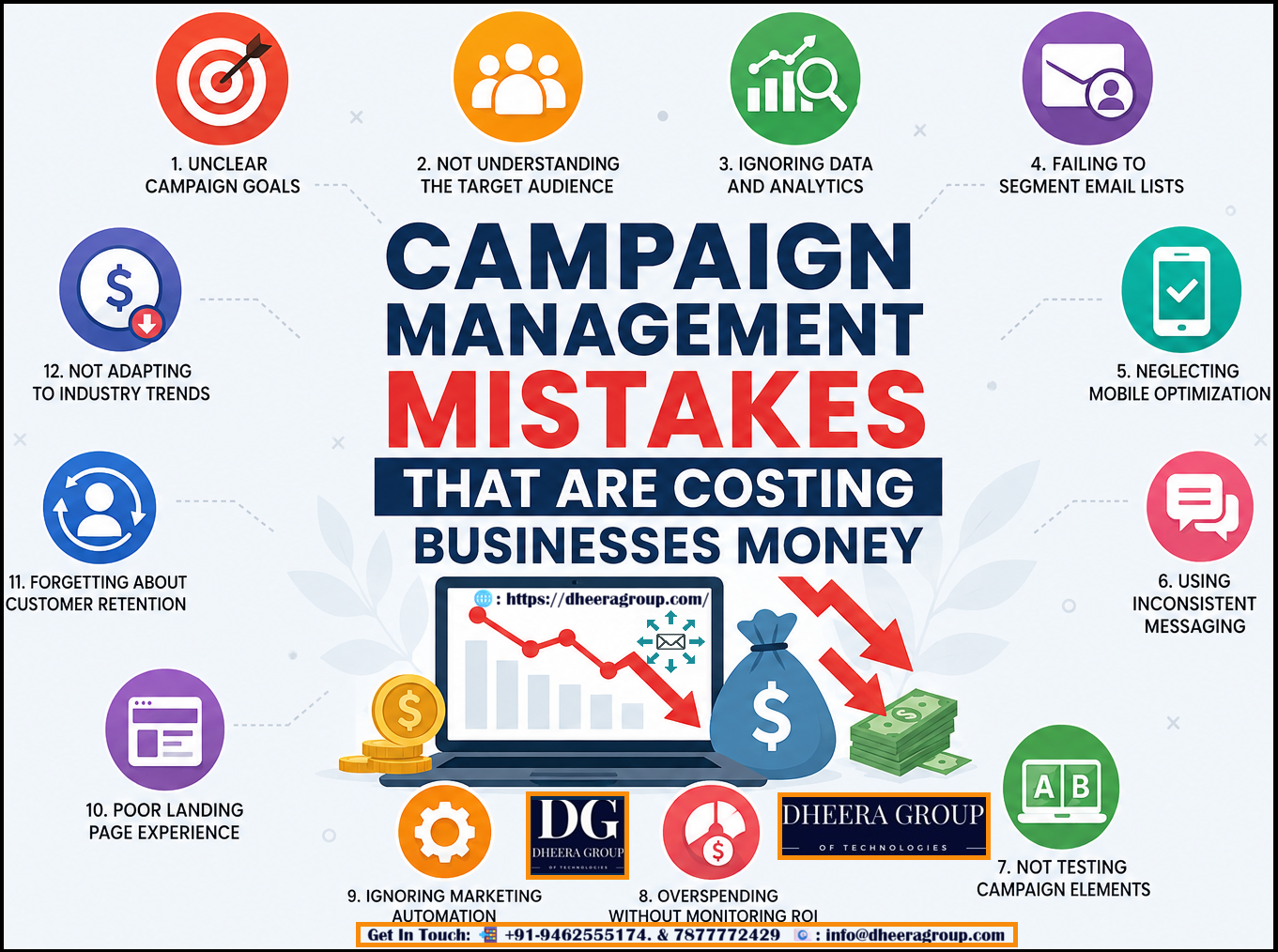

Successful marketing campaign management can help businesses generate leads, increase sales, and build lasting customer relationships. However, even the best products and services can struggle when campaign management is poorly executed. Many businesses invest significant budgets into email marketing, social media, paid advertising, and content marketing, only to see disappointing results because of avoidable mistakes.
Understanding these common campaign management mistakes can help businesses improve performance, maximize return on investment (ROI), and achieve sustainable growth.
1. Setting Unclear Campaign Goals
One of the biggest mistakes businesses make is launching campaigns without clearly defined objectives. A campaign without goals lacks direction and makes it difficult to measure success.
Common goals include:
- Increasing website traffic
- Generating leads
- Boosting sales
- Improving brand awareness
- Growing email subscribers
Before starting any campaign, establish SMART goals (Specific, Measurable, Achievable, Relevant, and Time-bound). Clear objectives help teams stay focused and make data-driven decisions.
2. Not Understanding the Target Audience
Many campaigns fail because businesses try to reach everyone instead of focusing on the right audience. Sending generic messages to a broad audience often results in low engagement and wasted marketing spend.
Businesses should:
- Analyze customer demographics
- Understand customer behavior
- Identify pain points
- Create buyer personas
- Segment audiences based on interests and preferences
Personalized campaigns are far more effective than one-size-fits-all marketing approaches.
3. Ignoring Data and Analytics
Campaign management should always be guided by data. Unfortunately, many businesses overlook important metrics and continue investing in underperforming campaigns.
Key performance indicators (KPIs) to monitor include:
- Click-through rates (CTR)
- Conversion rates
- Open rates
- Cost per acquisition (CPA)
- Return on investment (ROI)
- Website traffic
- Customer engagement
Regular analysis allows marketers to optimize campaigns and allocate budgets more effectively.
4. Failing to Segment Email Lists
Email marketing remains one of the highest-performing channels, but poor list management can significantly reduce results.
Sending the same email to every subscriber often leads to:
- Lower open rates
- Higher unsubscribe rates
- Increased spam complaints
- Reduced engagement
Businesses should segment email lists based on:
- Customer location
- Purchase history
- Interests
- Industry
- User behavior
Targeted email campaigns deliver more relevant content and generate better conversion rates.
5. Neglecting Mobile Optimization
With a majority of users accessing content through smartphones and tablets, mobile optimization is no longer optional.
Common mobile-related mistakes include:
- Slow-loading pages
- Non-responsive designs
- Tiny fonts
- Difficult navigation
- Unoptimized email templates
Poor mobile experiences can drive potential customers away and reduce campaign effectiveness.
To avoid this, ensure:
- Websites are mobile-friendly.
- Emails display properly on all devices.
- Landing pages load quickly.
- Forms are easy to complete.
6. Using Inconsistent Messaging
Consistency plays a major role in building trust and brand recognition. Many businesses create campaigns where advertisements, emails, and landing pages deliver different messages.
This inconsistency can confuse customers and lower conversions.
Maintain consistency across:
- Brand voice
- Colors and visuals
- Offers and promotions
- Call-to-action messages
- Customer experience
A unified message strengthens brand identity and improves campaign performance.
7. Not Testing Campaign Management Elements
Launching campaigns without testing can lead to missed opportunities and unnecessary expenses.
A/B testing helps businesses determine which elements perform best.
Items worth testing include:
- Subject lines
- Email content
- Headlines
- Images
- Call-to-action buttons
- Landing page designs
Even small improvements can significantly increase engagement and conversions over time.
8. Overspending Without Monitoring ROI
Many organizations allocate large budgets to advertising without regularly evaluating performance.
This can result in:
- Poor conversion rates
- Wasted ad spend
- Low-quality leads
- Negative returns
Businesses should continuously monitor:
- Cost per click
- Customer acquisition costs
- Conversion rates
- Revenue generated
Budget optimization ensures marketing dollars are spent wisely and efficiently.
9. Ignoring Marketing Automation
Manual campaign management can be time-consuming and prone to errors. Businesses that fail to embrace automation often struggle to scale their marketing efforts.
Marketing automation offers several advantages:
- Scheduled email campaigns
- Lead nurturing workflows
- Personalized communication
- Customer segmentation
- Performance tracking
Automation improves efficiency while delivering more relevant experiences to customers.
10. Poor Landing Page Experience
Driving traffic to a poorly designed landing page can undermine an otherwise successful campaign.
Common landing page mistakes include:
- Slow loading speeds
- Complicated forms
- Weak call-to-action buttons
- Too much information
- Lack of trust signals
Effective landing pages should be:
- Fast and responsive
- Visually appealing
- Easy to navigate
- Focused on one objective
- Optimized for conversions
A well-designed landing page can dramatically increase campaign success.
11. Forgetting About Customer Retention
Many businesses focus exclusively on acquiring new customers while neglecting existing ones.
Retaining current customers is often more cost-effective than attracting new prospects.
Retention strategies include:
- Email newsletters
- Loyalty programs
- Personalized offers
- Customer support
- Follow-up campaigns
Long-term relationships create repeat purchases and increase customer lifetime value.
12. Not Adapting to Industry Trends
Marketing trends evolve rapidly. Businesses that continue using outdated strategies risk losing market share to competitors.
Current trends shaping campaign management in 2026 include:
- AI-powered personalization
- Marketing automation
- Omnichannel campaigns
- Predictive analytics
- Interactive content
- Data-driven decision making
Staying updated with emerging technologies helps businesses remain competitive and maximize campaign performance.
How to Avoid Costly Campaign Management Mistakes
To improve campaign success, businesses should:
✅ Define clear goals before launching campaigns.
✅ Understand and segment their audience.
✅ Track performance metrics regularly.
✅ Optimize campaigns for mobile devices.
✅ Maintain consistent branding.
✅ Test different campaign elements.
✅ Monitor ROI continuously.
✅ Use automation tools to improve efficiency.
✅ Create high-converting landing pages.
✅ Focus on customer retention and long-term growth.
Conclusion
Campaign management is far more than simply launching advertisements or sending emails. Success requires planning, audience understanding, continuous optimization, and data-driven decision-making. Small mistakes can lead to wasted budgets, lower engagement, and missed revenue opportunities.
By avoiding these common campaign management mistakes, businesses can improve efficiency, increase conversions, and achieve better returns on their marketing investments. In today’s competitive digital landscape, smart campaign management is essential for sustainable business growth and long-term success.